
Microbial Source Tracking
Microbial Source Tracking Water Contamination DNA Testing
Know exactly where your water contamination is coming from. EBPI delivers Microbial Insights MST testing across Canada — using host-specific DNA markers to trace fecal contamination in surface water, groundwater, and recreational beaches back to its source: human sewage, cattle, dogs, birds, or wildlife.
Request a Sampling Kit Email EBPIKnow Where Your Water Contamination Is Coming From
Standard fecal indicator bacteria (FIB) testing confirms that contamination is present — it cannot tell you who or what is responsible. Microbial Source Tracking uses host-specific DNA markers (primarily in the Bacteroidetes group) to answer that question definitively, enabling targeted corrective action and defensible regulatory reporting.
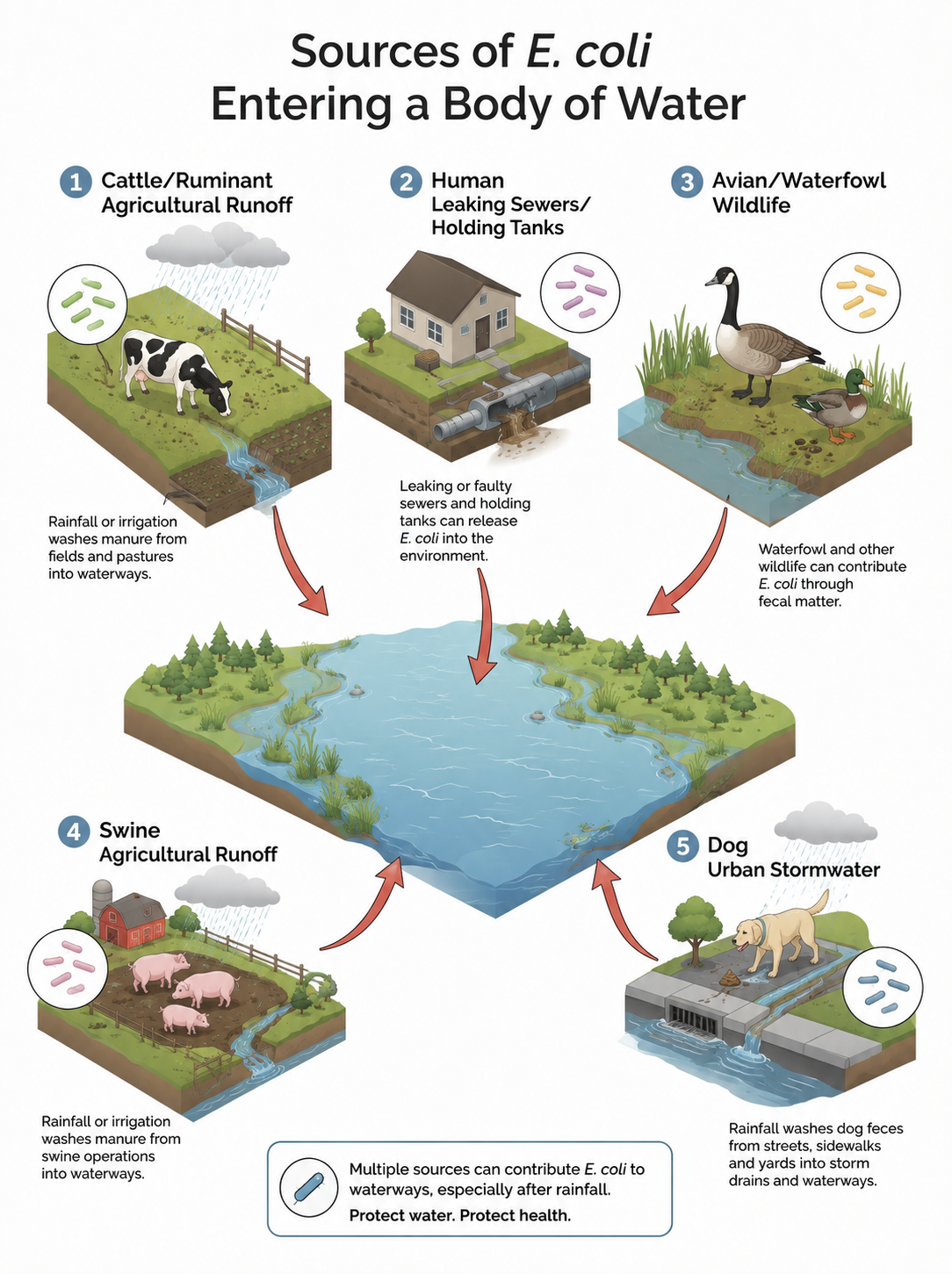
Fig. 1 — MST qPCR simultaneously attributes fecal contamination to multiple host species from a single water sample. All five contamination pathways converge at the sample point, where host-specific Bacteroidetes DNA markers identify each source independently.
Why Source Identification Matters
Actionable Results
Identifying the source (human sewage vs. cattle vs. wildlife) determines whether the solution is infrastructure repair, agricultural management, or no action required.
Regulatory-Grade Data
qPCR MST data is accepted by Health Canada, provincial health units, and watershed authorities for beach closures, Source Water Protection Plans, and DWSP assessments.
Cost-Effective Remediation
Without source identification, remediation budgets are wasted on the wrong interventions. MST data directs spending to the highest-impact corrective actions.
Human Health Risk Context
Human-sourced fecal markers carry significantly higher pathogen risk than ruminant or avian sources. MST provides health risk context that FIB counts alone cannot.
What MST Tests Detect
Each host species harbours distinct Bacteroidetes populations in their gut microbiome. EBPI coordinates Census® MST panels targeting the markers most relevant to Canadian watershed conditions and land use.
Human
Indicates untreated sewage, CSO/SSO events, or failed septic systems. Highest public health significance.
Ruminant / Cattle
Agricultural runoff, feedlot drainage, and cattle access to waterways — common in Canadian rural watersheds.
Dog
Urban stormwater, parks, and recreational areas — often underestimated as a contamination source in municipal watersheds.
Avian / Bird
Gulls, geese, and waterfowl — significant seasonal sources at beaches and stormwater ponds.
Swine
Hog operations and manure spreading in agricultural regions of Ontario, Manitoba, and Quebec.
Wildlife
Deer, raccoon, beaver, and other wildlife — important context for source water protection and wildlife management decisions.
Analytical Services Available Through EBPI Canada
Census® qPCR (MST)
Quantitative host-specific marker testing — single species or multi-marker panel. Results in gene copies per 100 mL, directly comparable to FIB standards and beach action thresholds.
Water Sample Filtration
EBPI supplies standardized filtration kits for grab samples and composite sampling. Local processing avoids DNA degradation from international pre-shipment delays.
FieldQuant™ Rapid Testing
Portable qPCR for same-day results in the field — invaluable for beach management during rain events and active CSO/SSO investigations.
Bio-Extract™ Field Extraction
Field-stable DNA extraction preserving microbial genetic material from water filters for transport to EBPI — critical for remote Canadian field sites.
Results Interpretation & Reporting
EBPI translates qPCR data into source attribution reports suitable for municipal councils, conservation authorities, health units, and regulatory submissions.
Seasonal Monitoring Programs
Structured multi-point, multi-event sampling programs for beach surveillance, watershed characterization, and Source Water Protection Plan development.
Where MST Is Applied in Canada
Beach & Recreational Water
Seasonal monitoring, beach closure investigation, and public health reporting for municipal and provincial bodies
Source Water Protection
Supporting municipal Drinking Water Source Protection Plans under Ontario’s Clean Water Act and equivalent provincial programs
Agricultural Watersheds
Characterizing cattle, swine, and poultry contributions in rural watersheds for nutrient management and SWPP compliance
Urban Stormwater
Distinguishing pet and wildlife sources from failing sewer infrastructure in municipal stormwater investigations
Regulatory Compliance
Supporting compliance investigations for First Nations water systems, provincial parks, and federal contaminated sites on water bodies
Shellfish Harvesting Areas
DFO and CFIA-aligned source tracking for commercial and First Nations shellfish harvest area closures and re-openings
🍁 Purpose-Built for Canadian Water Management
EBPI understands the regulatory landscape for MST data in Canada — from Conservation Authority Source Water Protection Plans to Health Canada beach guidelines and DFO shellfish area requirements. We provide local filtration and processing, regional expertise on land use context, and results that stand up to scrutiny from provincial and federal reviewers.
Common Questions
- How do I collect a water sample for MST testing?
- EBPI supplies standardized filtration kits — typically 100 mL to 1 L water filtered onto a 0.22 µm membrane at the field site. Filters are preserved and shipped on ice to EBPI for DNA extraction before forwarding to Microbial Insights for qPCR analysis. Detailed SOPs are provided with every kit.
- How does MST qPCR compare to conventional E. coli testing?
- E. coli and total coliform testing confirms fecal contamination is present, but these organisms are not host-specific — they inhabit the guts of all warm-blooded animals. MST qPCR uses Bacteroidetes markers that are highly host-specific, allowing definitive attribution to human, cattle, dog, bird, or other sources from the same water sample.
- Is MST data accepted by Canadian health and environmental regulators?
- Yes. MST molecular data is used in Ontario, BC, Quebec, and federally in Source Water Protection Plans, beach management decisions, and DWSP assessments. EBPI can advise on data presentation requirements for specific regulatory contexts. The qPCR methods used by Microbial Insights are among the most peer-reviewed in the field.
- Can MST identify mixed sources simultaneously?
- Yes — a multi-marker MST panel runs all host-specific markers in parallel from the same DNA extract. Results report the gene copy concentration for each source independently, fully characterizing mixed-source contamination events common in agricultural watersheds following rainfall.
- What is the minimum sample volume required?
- Typically 100 mL for clear water samples, or 500 mL–1 L for turbid or low-biomass samples to ensure sufficient template DNA. EBPI provides guidance based on expected contamination levels and site-specific water quality conditions.
Contact EBPI to discuss your watershed or beach investigation, select the right MST markers, and receive a complete sampling kit with field protocols.